

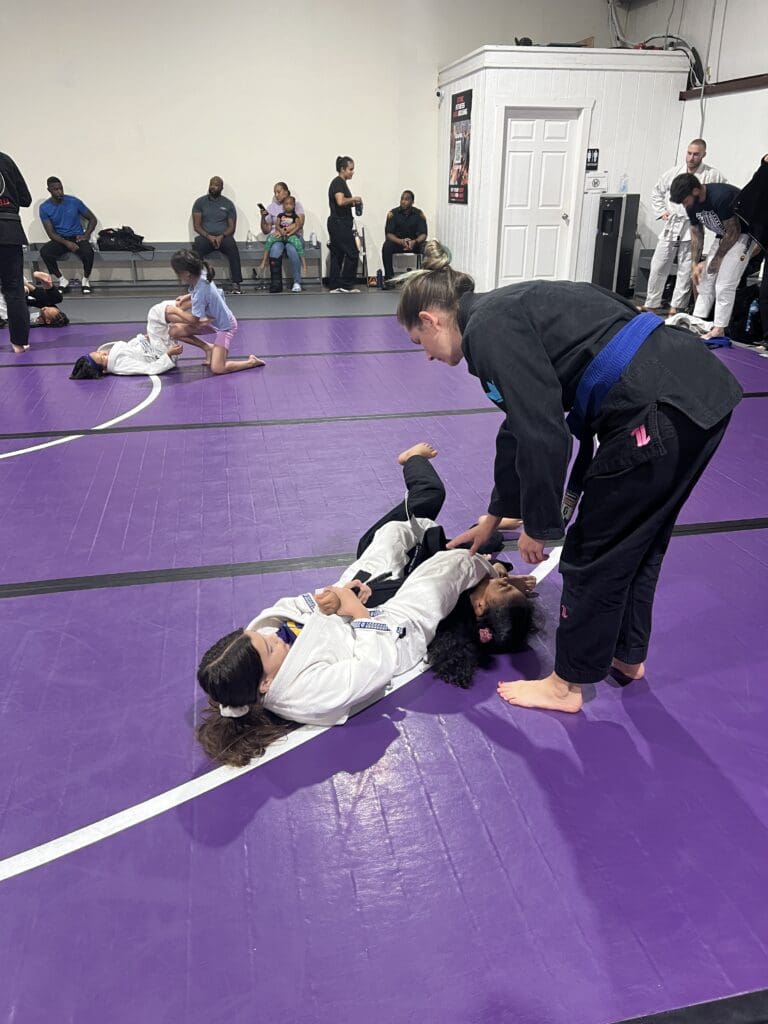
What’s the best age to start jiu jitsu? Here’s the short version. Kids can start structured classes at 4. The easiest window for building real skill runs from about 7 to 12. And there is no age where the door closes. Four-year-olds and forty-year-olds walk onto our mats in Mansfield every week, and both belong there.
The longer answer depends on whose age we’re talking about, yours or your kid’s. This guide goes band by band, the way we actually see it play out at the gym: what a class looks like at each age, what parents should expect, and how to tell when a kid is ready. If reading isn’t your thing, skip all of it and book a free trial class. The trial is free on its own, no membership attached. Age questions get answered faster on the mats than on a blog.
The Short Answer on the Best Age to Start Jiu Jitsu
- Ages 4 to 6: yes, with the right program. Classes at this age are games wearing a gi. That’s by design.
- Ages 7 to 12: the sweet spot. Old enough to follow technique, young enough that learning movement feels like play.
- Ages 13 to 17: a great time to start. Teens pick up technique fast and the confidence shows up everywhere else.
- Adults: whenever you decide to. The best age to start jiu jitsu was probably a few years ago. The second best is now.
That’s the whole chart. The rest is detail.
What Age Can Kids Start Jiu Jitsu?
Four. That’s the practical floor at most schools that run a dedicated little-kids program, and it’s the floor at ours. Our preschool BJJ program in Mansfield takes ages 4 to 6.
Under 4, most kids aren’t ready for a structured class, and pushing it early tends to burn the interest before it starts. The American Academy of Pediatrics says most kids are ready for organized sports around age 6, and that younger kids do best with play-based movement. That’s exactly why a good 4-to-6 class is built out of games instead of drills. It meets the AAP’s point instead of fighting it.
One honest note: readiness varies kid to kid more than it varies by birthday. We’ve seen focused four-year-olds and squirrelly six-year-olds. The trial class exists to answer this question for your specific kid, free, in about an hour.
Ages 4 to 6: Games First, Jiu Jitsu Second
At this age nobody is learning armbars. A good preschool class is animal walks, balance games, grip games, learning to fall without fear, and taking turns. The jiu jitsu is hidden inside the games the way vegetables get hidden in spaghetti sauce.
What your kid actually gets: body control, listening skills, comfort with contact, and a coach who is not their parent telling them to wait their turn. What you get: a tired kid. Everybody wins.
Ages 7 to 12: The Skill-Building Window
Ask coaches in any grappling sport and most will point here. Kids from 7 to 12 can follow multi-step technique, they drill without dying of boredom, and movement patterns learned now stick for life. Our kids BJJ classes cover ages 7 to 12 for exactly that reason.
This is also the age where jiu jitsu starts doing its quiet work on behavior. Losing a round and lining back up. Winning one and shaking hands anyway. Getting flattened by a smaller kid with better technique and deciding to learn instead of quit. You can lecture that stuff at the dinner table for years, or a blue mat can teach it in a month.
Teens: Ages 13 to 17
Starting as a teen is not late. It might be the most underrated age to start jiu jitsu. Teens have the focus little kids lack and none of the stiffness adults bring, so progress comes fast, and fast progress is addictive in the best way.
It lands at the right moment too. High school is a confidence meat grinder. A teen BJJ program hands a fourteen-year-old something real that nobody at school can take away: proof they can do hard things. We keep teens in their own class, not thrown in with adults, because a 13-year-old and a 35-year-old should not be sparring partners.
Too Old to Start Jiu Jitsu? There’s No Such Age
Mats don’t card you. Adults start jiu jitsu at 25, 35, 50, and older, and the sport bends to meet them. Technique over strength isn’t a slogan, it’s the whole design of the art. You control the pace, you pick your training partners, and a decent gym culture protects its beginners.
Will a 45-year-old progress like a 19-year-old? No. Doesn’t matter. You’re not competing with the 19-year-old, you’re competing with the version of you that stayed on the couch. Our adult BJJ classes are built for exactly this range of people, and if budget is the question instead of age, we broke down what jiu jitsu classes cost in plain numbers.
Signs Your Kid Is Ready to Start
Forget the birthday. Watch for these instead:
- Follows two-step instructions from an adult who isn’t you.
- Can separate from you for 30 minutes without a meltdown.
- Wrestles the couch, the dog, or a sibling for fun.
- Can wait for a turn, even badly.
- Shows interest when they see other kids doing it.
Three out of five is plenty. The trial class tells you the rest. And if the answer turns out to be “not yet,” that’s a fine answer. Six months changes a lot at this age, and the gym will still be here.
Starting at Stoic in Mansfield, at Any Age
Here’s how the age bands work at our gym: preschool for ages 4 to 6, kids for 7 to 12, teens for 13 to 17, and adults for 18 and up. Everyone trains with their own age group. Nobody gets thrown to the wolves. And at kids classes, parents sit right at the edge of the mat. You watch your kid train with your own eyes, not through a lobby camera.
Your first class is free, kid or adult, no membership attached. Join, and your first gi is on us. If you’re still weighing gyms, our guide to choosing a BJJ gym in Mansfield covers what to look for in a trial class anywhere, including ours.
We’re at 1910 Lone Star Rd in Mansfield. Call or text (817) 225-2110 and tell us the age. We’ll take it from there.
The best age to start jiu jitsu is the one on this year’s birthday cake. Come train.